Safety File South Africa: The Complete (Non-Boring) Guide to What Actually Goes Inside
Safety file South Africa guide: the 7 sections every OHS Act and Construction Regulations 2014 safety file must contain, what principal contractors actually check, and templates.
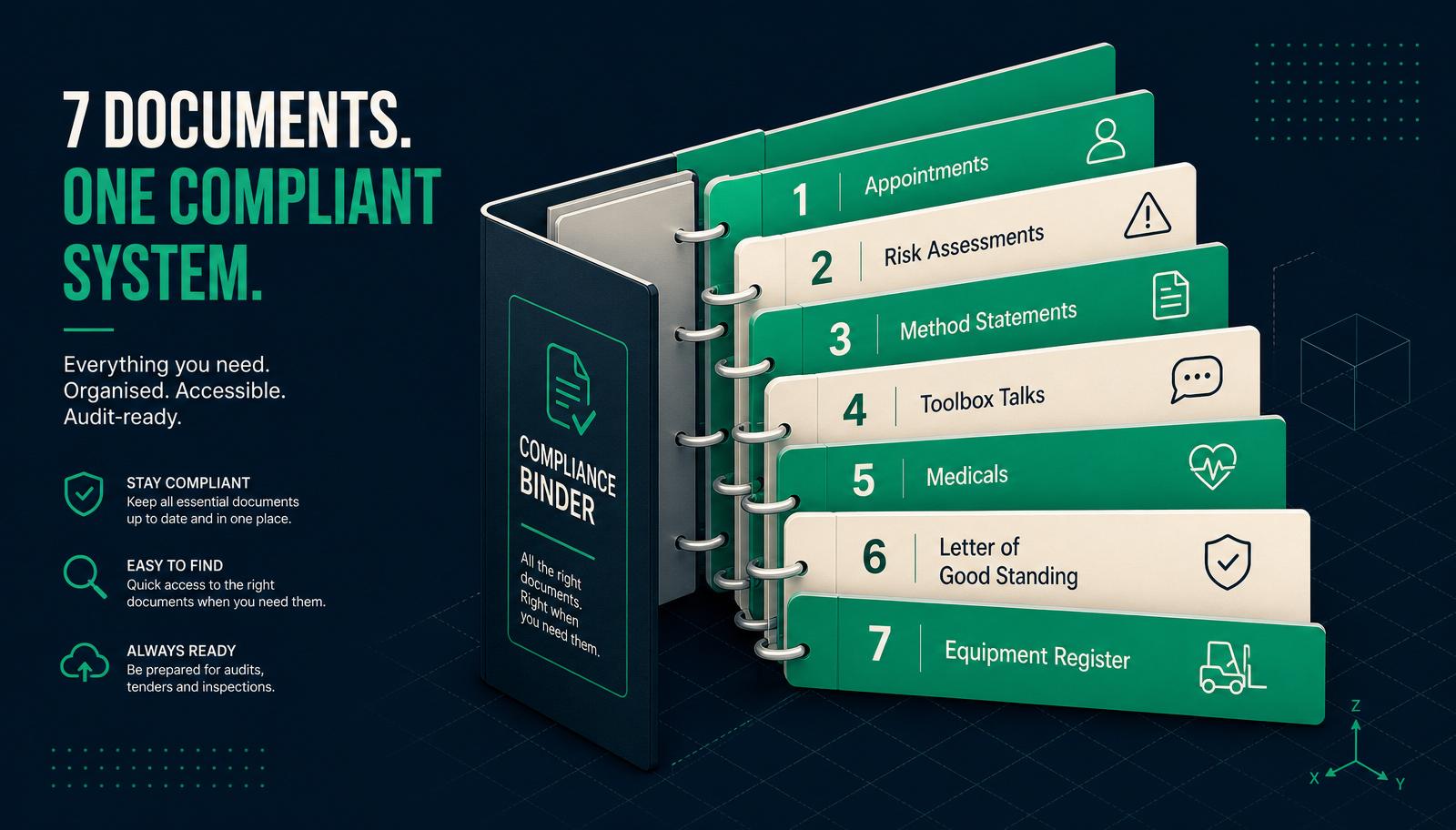
Ask ten safety officers what belongs in a safety file and you''ll get eleven answers. Ask the Department of Employment and Labour, and you''ll get the Construction Regulations 2014, Section 7 — which basically says "everything relevant." Helpful. Thanks.
Here''s the good news: the core of a South African safety file is remarkably consistent across principal contractors. Master this and you''ll pass 90% of file audits on the first pass.
What a safety file actually is
A safety file is the working record that proves your company, your people, your equipment, and your method of work are compliant with the Occupational Health and Safety Act (Act 85 of 1993) and the Construction Regulations 2014. It lives on site, in a lever-arch file or on a tablet, and it must be produced on demand for the client, the principal contractor, or an inspector.
The seven sections every SA safety file needs
- Company documents. CIPC registration, tax clearance, VAT, BBBEE, Letter of Good Standing, public liability insurance.
- Legal appointments. Section 16(2), Construction Manager (8.1), Construction Supervisor (8.7), First Aider, Fire Marshal, Incident Investigator — signed and dated, on your letterhead.
- Risk management. Baseline Risk Assessment, Issue-Based Risk Assessments, and the Safe Work Procedures / Method Statements for each activity.
- Employee compliance. CVs, ID copies, medicals (Certificates of Fitness), inductions, competency certificates (working at heights, first aid, forklift, etc.).
- Equipment and PPE. Inspection registers for ladders, harnesses, electrical tools, lifting gear, plus PPE issue registers.
- Emergency preparedness. Emergency plan, evacuation drills, first-aid box contents, incident register.
- Client-specific documents. The principal contractor''s OHS Specification, signed 37(2) agreement, site-specific inductions, and the mandatory notification of construction work where applicable.
Why every safety file looks different (and drives you slightly mad)
Because every principal contractor writes their own OHS Specification. Anglo wants one layout, WBHO wants another, a boutique property developer just wants "the thing my consultant asked for." So you rebuild the file. Every. Single. Time.
You rename PDFs. You re-order sections. You email the same LOGS to the same estimator for the fourth time this quarter. Multiply that across five active sites and you''ve just lost a whole administrator to formatting.
How SitePass eats this problem for breakfast
SitePass stores your company, employee, and equipment documents once. When a new project starts, you pick the principal contractor''s template (or upload their OHS Spec and let our AI parse it), and SitePass assembles a fully-indexed, correctly-named, cover-paged safety file in minutes. Expiries get watched automatically. Missing documents get flagged before the client asks.
Fewer late nights. Fewer rejected files. More time on the tools.
See how contractors use SitePass or start a free trial — no card needed.
FAQ: Safety Files in South Africa
What is a safety file in South African construction?
A safety file is the on-site legal record proving your company complies with the Occupational Health and Safety Act 85 of 1993 and the Construction Regulations 2014. It contains appointments, risk assessments, method statements, medicals, LOGS, and equipment records.
Who is responsible for the safety file — the client or the contractor?
Every contractor and sub-contractor compiles their own safety file. The principal contractor collects and audits them. The client appoints the principal contractor under Construction Regulation 5.
How much does a safety file cost in South Africa?
A safety consultant will typically charge R3,500 to R15,000 per project depending on scope. With SitePass you generate the file yourself from documents you already have on the platform, in minutes, for the price of a monthly subscription.
Can a safety file be digital or does it have to be a lever-arch folder?
Digital is fully accepted, provided the file can be produced on demand for the client, principal contractor, or Department of Employment and Labour inspector. Most modern sites now accept a QR code or shared link.