Risk Assessments vs Method Statements: What Principal Contractors Actually Want
They sound similar, they show up in the same safety file, and contractors confuse them constantly. Here is the difference, why it matters legally, and what a principal contractor actually checks first.
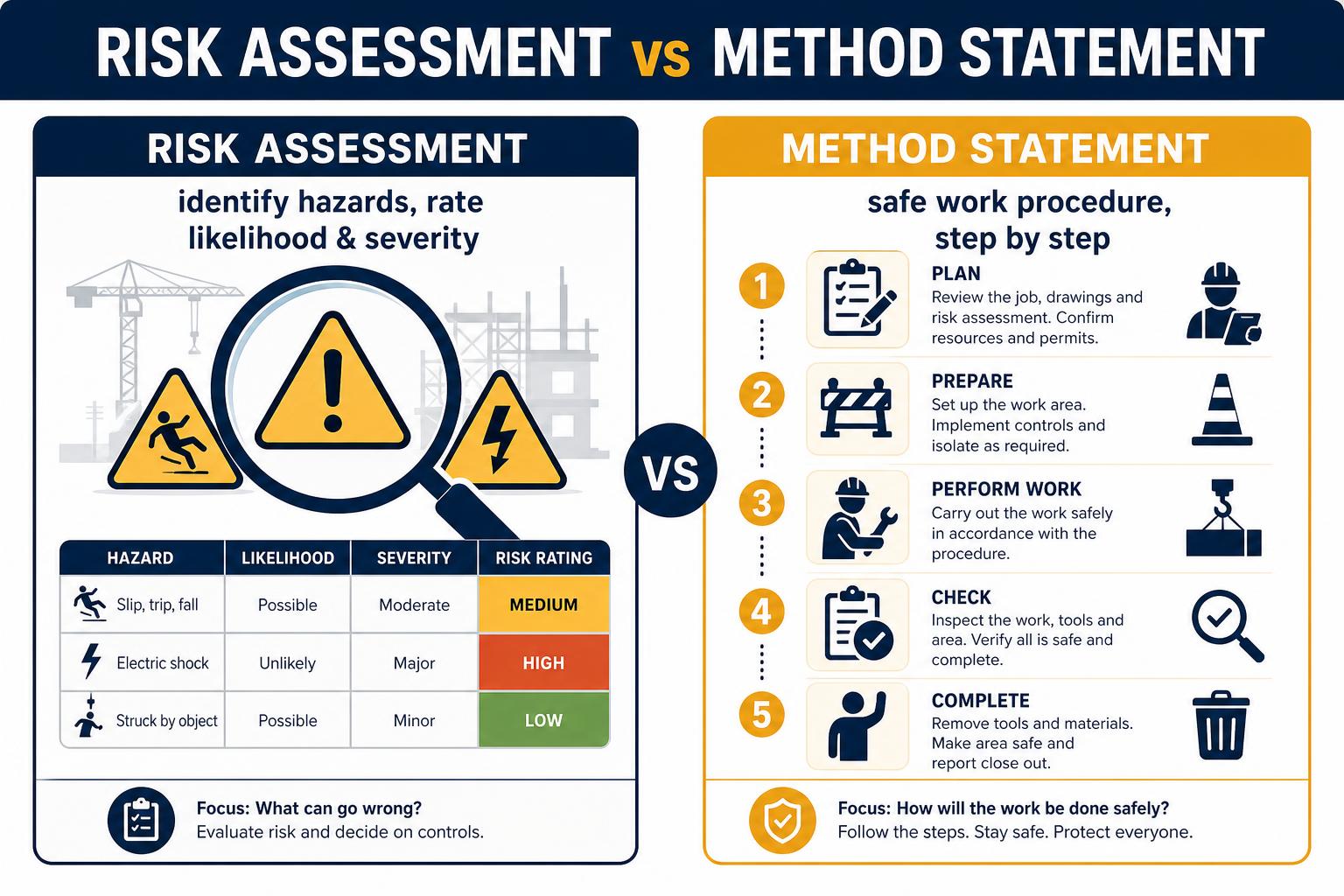
Ask ten contractors what the difference is between a risk assessment and a method statement and you will get ten slightly different answers. Ask a principal contractor's safety officer the same question and you will get one very specific answer — because it is the difference between a safety file that gets approved and one that gets sent back.
The legal basis
Under the Construction Regulations 2014, every contractor must conduct a hazard identification and risk assessment (Reg. 9) before any work begins, and produce safe work procedures for every activity identified as high-risk. The "method statement" is the industry term for that safe work procedure document.
Risk Assessment — what can go wrong
A risk assessment answers one question: what can hurt someone doing this work, and how bad is it? It is an analytical document. The typical structure:
- Activity or task being assessed
- Each hazard identified for that task
- Likelihood rating (rare → almost certain)
- Severity rating (minor → catastrophic)
- Risk rating (likelihood × severity)
- Control measures to reduce the risk
- Residual risk after controls
- Signature of the appointed 8.1 supervisor
Method Statement — how the work will be done safely
A method statement answers a different question: given the risks, what is the step-by-step procedure the team will follow? It is an operational document. The typical structure:
- Scope of work
- Resources required — people, plant, materials, PPE
- Step-by-step procedure, in order
- Control measures referenced from the risk assessment
- Emergency procedures specific to this task
- Sign-off by supervisor and toolbox-talk record
The quick comparison
| Risk Assessment | Method Statement | |
|---|---|---|
| Question it answers | What can go wrong? | How will we do it safely? |
| Format | Matrix / table of hazards | Numbered procedural steps |
| Author | Competent risk assessor + 8.1 | Site supervisor / engineer |
| Audience | Management, client, auditor | The team doing the work |
| Updated when | Scope, site, or hazards change | Procedure or resources change |
What principal contractors check first
Two things, every time:
- Do the hazards in the risk assessment match the actual scope of work? A roofing contractor with no "working at heights" line item gets rejected on the spot.
- Does the method statement reference the controls from the risk assessment? If the RA says "use a full-body harness" and the MS doesn't tell the worker when to clip on, the documents are disconnected and the file fails.
How SitePass helps
SitePass keeps your risk assessments and method statements linked, version-controlled, and signed by the right appointed person — so when a principal contractor opens your safety file, the two documents already tell the same story. That is what turns a "please resubmit" into a "you are cleared to start."