The 2026 Construction Safety File Checklist Every South African Contractor Needs
A practical, OHS Act–aligned checklist of every document a principal contractor will demand before you set foot on site in 2026 — and the common mistakes that get safety files rejected.
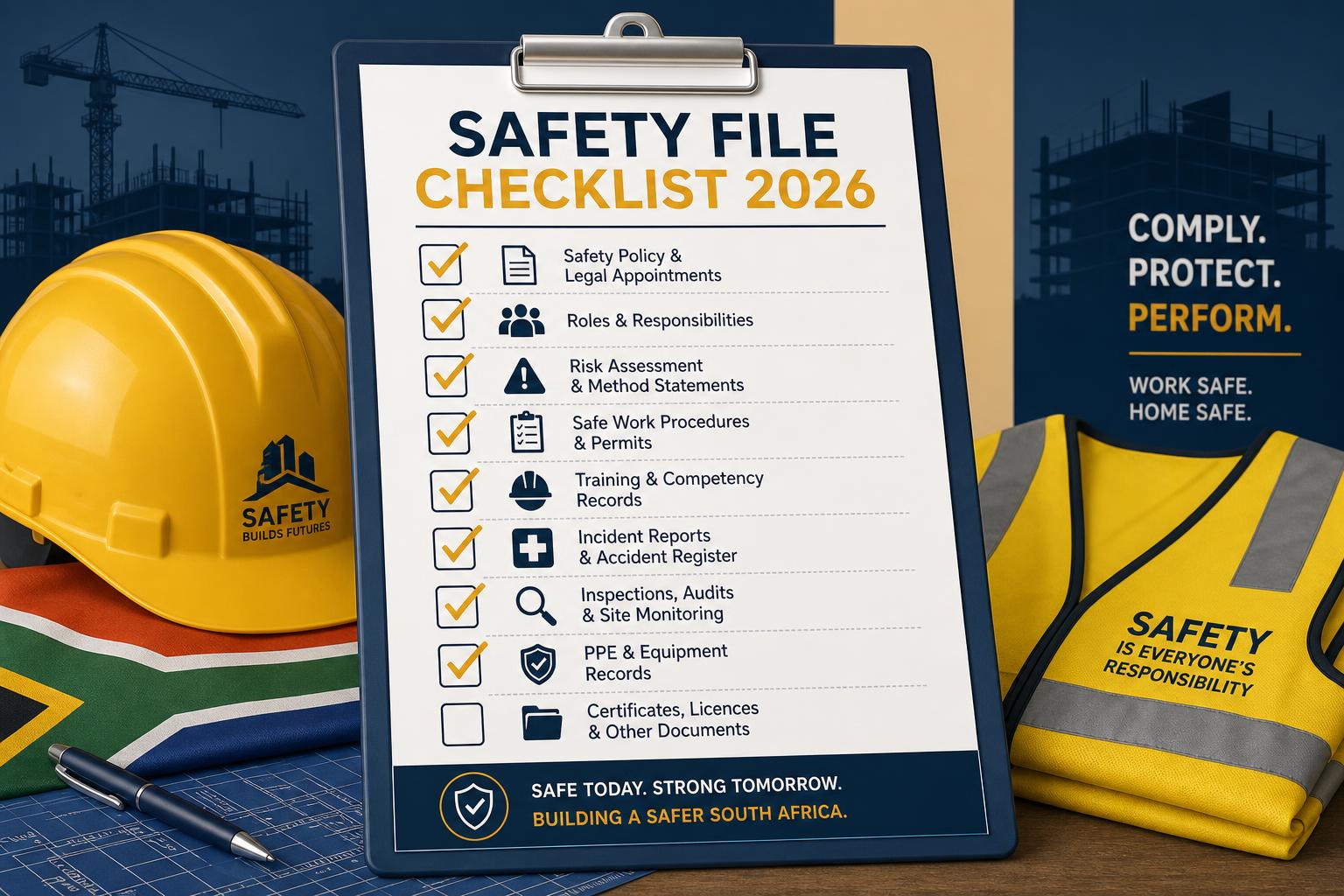
If your safety file gets rejected at the gate, your team goes home, your project loses a day, and your client starts questioning the relationship. In 2026, principal contractors and consultants are tighter than ever on what they will accept — driven by Construction Regulations 2014, Section 37(2) of the OHS Act, and insurer pressure after a brutal few years of site incidents.
This is the checklist we use at SitePass when we audit a contractor's safety file. Work through it line by line before you submit.
Why safety files exist (the legal bit, briefly)
The Occupational Health and Safety Act 85 of 1993, read with the Construction Regulations 2014, makes the principal contractor responsible for the health and safety of everyone on site — including your team. To discharge that duty they need documented proof that you are competent, insured, trained, and have planned the work safely. That bundle of proof is your safety file.
The non-negotiable checklist
- Letter of Good Standing from the Compensation Fund (or a licensed COID insurer) — valid for the project duration.
- Section 37(2) Mandatary Agreement signed between you and the principal contractor.
- Notification of Construction Work to the Provincial Director (where applicable under Reg. 3).
- OHS Policy signed by your CEO and dated within the last 12 months.
- Legal appointments — 16.2, Construction Supervisor (8.1), Construction Health & Safety Officer (8.5) where required, First Aider, Fire Marshal, Incident Investigator.
- Risk Assessments specific to the scope of work, signed by the appointed 8.1 supervisor.
- Safe Work Procedures / Method Statements for every high-risk activity.
- Fall Protection Plan if anyone will work above 2 metres.
- Induction records — site-specific induction, signed by every worker.
- Medical certificates of fitness for each worker, valid and scope-appropriate.
- Competency certificates — first aid, scaffolding, working at heights, plant operation, etc.
- PPE issue register with worker signatures.
- Plant & equipment inspection registers — ladders, harnesses, power tools, electrical equipment.
- Emergency procedures aligned to the site's emergency plan.
- Incident, injury, and near-miss registers — empty is fine, but the templates must be there.
Common mistakes that get files rejected
- Generic risk assessments. Copy-paste assessments that don't match the actual scope are the #1 reason for rejection. The 8.1 supervisor must sign and the hazards must be real for your task.
- Expired Letter of Good Standing. Check the expiry date the day you submit — not the day you compiled the file.
- Missing Section 37(2) agreement. Without it, the principal contractor is legally exposed and will not let you start.
- Appointment letters with no acceptance. An appointment is only valid once the appointee has signed back.
- Medicals that don't match the scope. A "fit for office work" certificate doesn't cover working at heights.
What "good" looks like in 2026
The bar has moved. A modern safety file is version-controlled, indexed, and accessible from the site office in under thirty seconds. Paper files still pass, but increasingly clients want a shareable link they can audit from their desk. Either way, the content above is what they will look for.
If you compile your file against this checklist and the documents are current, you will pass 95% of site gate audits in South Africa.