COIDA Registration in South Africa: The No-Nonsense Guide for Employers
COIDA registration South Africa: step-by-step guide for employers to register with the Compensation Fund, submit the Return of Earnings, and get your Letter of Good Standing.
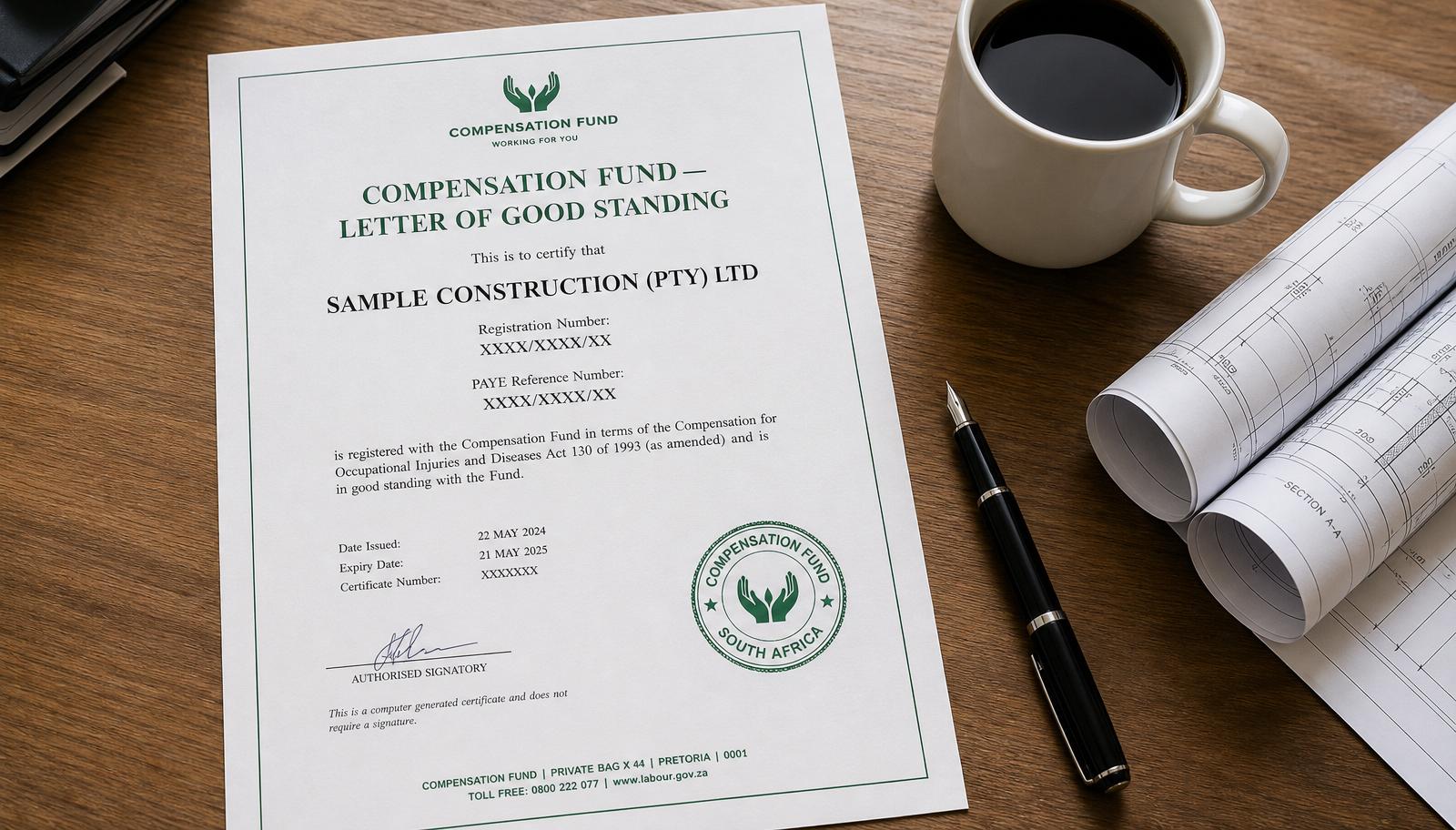
COIDA is the law that says: "If your worker gets hurt on the job, they get paid and treated — and it''s the state that pays, not you." In return, every employer contributes to the Compensation Fund based on payroll and risk class.
Skip it and you''re personally liable for the medical bills, lost wages, and disability of any injured worker. Plus you can''t get a Letter of Good Standing, which means you can''t get on site. Which means you can''t get paid. You see the loop.
Who has to register
Every employer with one or more employees, including casuals, temps, and family members on payroll. Domestic workers are also included since the 2020 amendments (thanks to the Mahlangu Constitutional Court judgement). Sole proprietors with no employees are not required to register but can voluntarily insure themselves via a separate scheme.
What you need before you start
- Company registration documents (CIPC)
- SARS tax reference number
- Banking details (proof)
- Estimated annual earnings for the current financial year
- Nature of business (this determines your industry class and rate)
How to register
- Create a CompEasy account at the Department of Employment and Labour portal.
- Complete the W.As.2 registration form online.
- Upload supporting documents.
- Wait for your Compensation Fund registration number (usually within 2–4 weeks — occasionally faster, occasionally very much not).
- Submit your first Return of Earnings, receive your assessment, pay it, and download your Letter of Good Standing.
The Return of Earnings (ROE)
The ROE (W.As.8) is due annually between 1 April and 31 May. You declare actual earnings for the previous year and estimate the current year. Late submission = penalties. Non-submission = no LOGS = no site access.
Keep this date in a calendar. Then in another calendar. Then in a WhatsApp reminder. Then still miss it because life. (Or… let SitePass remind you.)
What COIDA actually costs
Your assessment is calculated as: Total annual earnings × your industry tariff rate. Rates vary wildly by class:
- Office / admin businesses: often under 0.30%
- General building contractors: around 1.5% – 2.5%
- Roofing, demolition, structural steel: significantly higher
Payroll capped per employee at the annually gazetted maximum (currently in the R500k+ range — check the latest Gazette).
Common mistakes we see all the time
- Registering the trading name instead of the CIPC-registered entity
- Under-declaring earnings to save on the assessment (this becomes fraud and voids cover)
- Forgetting to add newly-hired employees
- Letting the LOGS expire mid-project because nobody was watching
Where SitePass helps
SitePass stores your COIDA registration, Letter of Good Standing, and Return of Earnings receipts in one place, watches the expiry, and blocks nothing on your site because the paperwork was three days out of date. When a principal contractor asks for the file, everything is one click away.
Explore SitePass for contractors or start a free trial — no card needed.
FAQ: COIDA Registration South Africa
Who has to register for COIDA in South Africa?
Every employer with one or more workers — full-time, part-time, casual, or seasonal. Directors and members are excluded, but domestic workers were added by the COIDA Amendment Act 10 of 2022.
How do I register for COIDA online?
Register through the CompEasy portal at cfonline.labour.gov.za. You will need your CIPC registration, tax number, bank details, PAYE reference, and estimated annual earnings by employee category.
What is a Return of Earnings (W.As.8) and when is it due?
The ROE is the annual declaration of actual and estimated earnings submitted to the Compensation Fund between 1 April and 31 May. It drives your next assessment and your Letter of Good Standing eligibility.
What happens if I do not register for COIDA?
You cannot obtain a Letter of Good Standing, which means you cannot legally work on almost any South African construction site. You are also personally liable for the full cost of any workplace injury — medical, disability, and loss of earnings.